 |
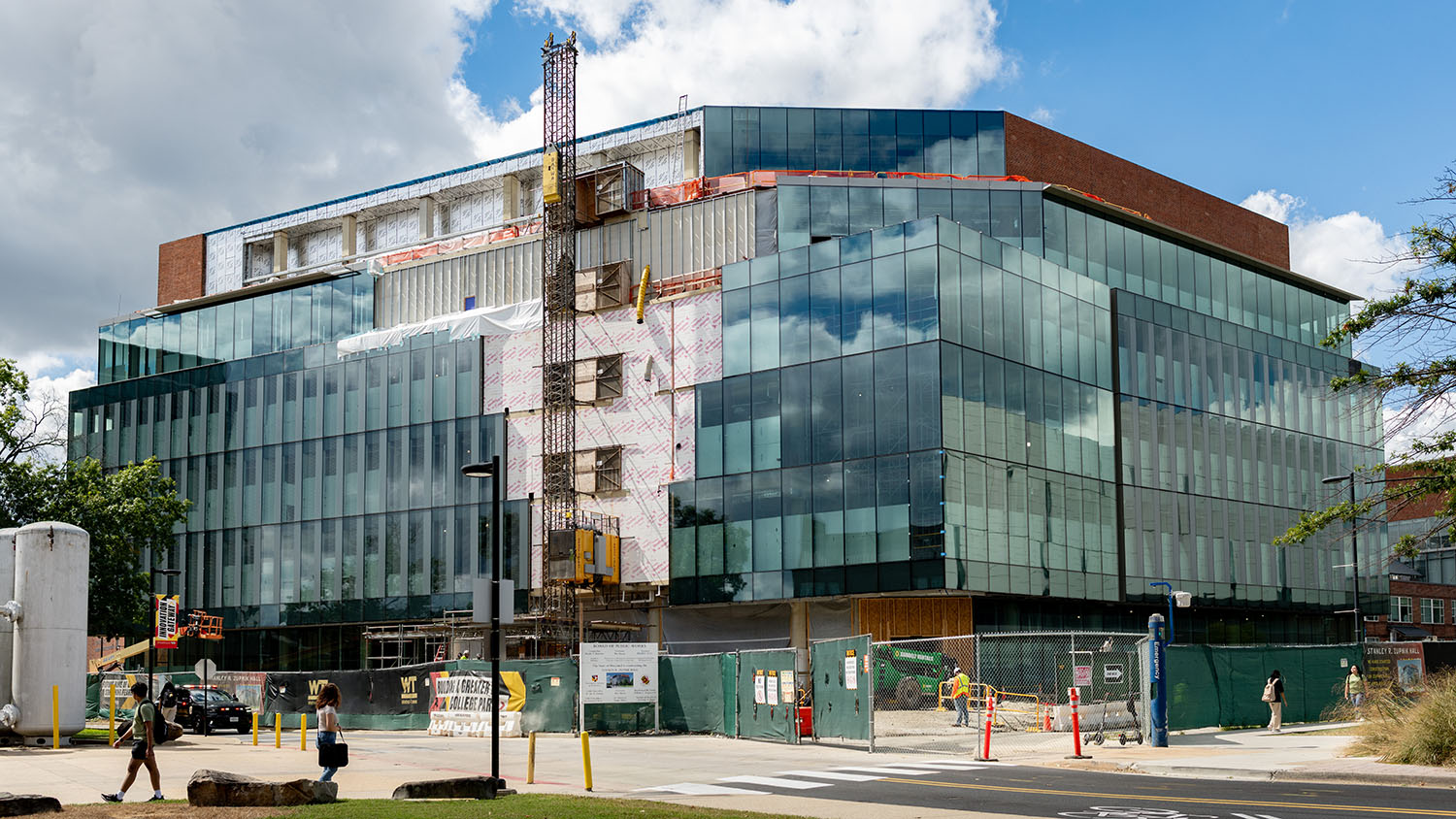
Construction of Stanley R. Zupnik Hall, one of the A. James Clark School of Engineering’s newest facilities, moves into the finishing stage, on schedule for completion with the initial installation of furniture and some equipment set for Summer 2026 and a dedication ceremony in Spring 2027.
“The innovations that we generate in Zupnik Hall will change the world,” Clark School Dean Samuel Graham said. “Maryland Engineering is home to facilities that bridge disciplines inside and outside of engineering, and Zupnik Hall will be a world-class addition. Building a better future requires engineers, scientists, business leaders, and more working together. Zupnik Hall will be a hub for their great ideas.”
Interdisciplinary learning and quantum research
In the center of the Maryland Engineering complex, the 162,000-square-foot building will be the school’s new hub for interdisciplinary engineering. It will house:
The University of Maryland Quantum Technology Center (QTC) will also expand its total number of labs, educational spaces, and offices in the new building, which aligns with UMD President Darryll J. Pines’ vision of developing the region as the Capital of Quantum with UMD at its center. “Zupnik Hall is one of the few spaces on campus where quantum research can be conducted,” said Bill Olen, UMD’s interim associate vice president and chief facilities officer.
The building structure, including concrete, steel, and exterior metal framing, and sheathing and installation of exterior glass were largely completed in Fall 2025. The finishing touches of device and equipment installation, including light fixtures, chilled beams, diffusers, grilles, and lab equipment that requires hard pipe, duct, and electrical connections, will progress from the basement level to the upper floors in sequence.
Sustainability focused with distinct features
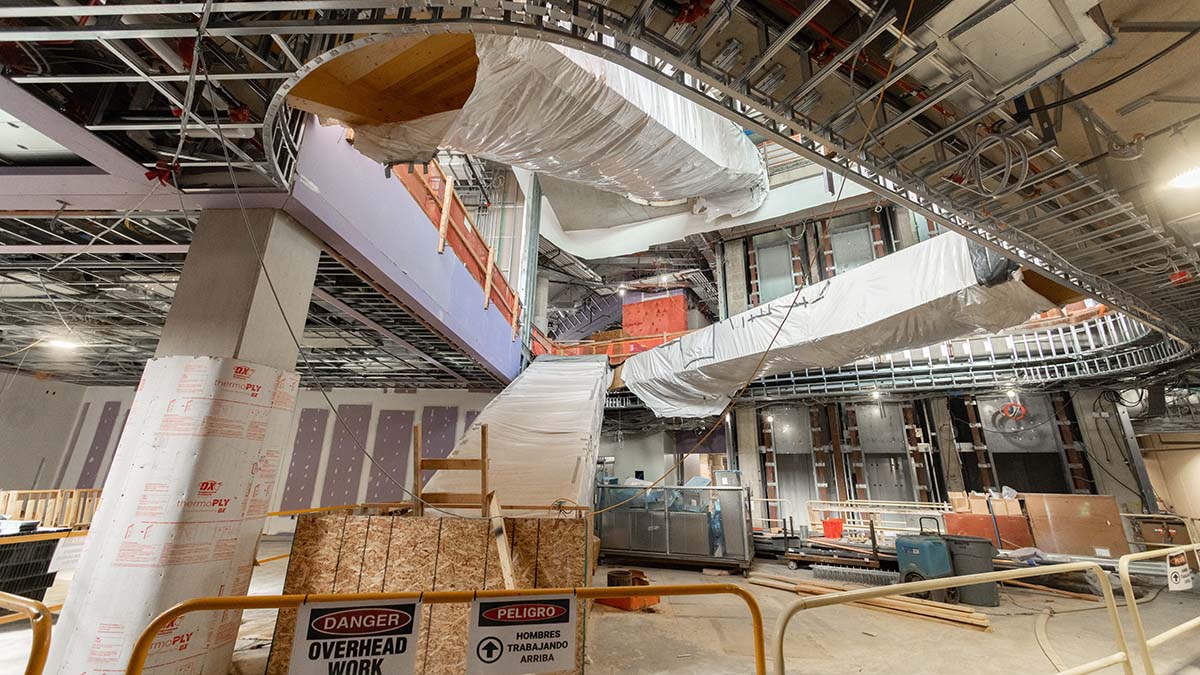
In keeping with UMD energy reduction goals, Olen added, “Zupnik Hall is designed to be the first operationally net carbon-zero building on campus.” For example, chillers in the thermal plant adjacent to Zupnik Hall currently provide chilled water for neighboring buildings. That heat is fed through the Zupnik Hall heat recovery plant, which provides the new building with chilled and low-temperature hot water as well as provides the Chemistry Building with low-temperature hot water.
Zupnik Hall is home to one of the largest atria and the first mass-timber staircase on campus. As in many of today’s sustainable buildings, wood is an important element in Zupnik Hall. Its natural wood staircase (European spruce) was fabricated and assembled off-site, and the five individual staircases were dropped into the building by tower cranes earlier this year. While the staircase is set, glass guard rails and terrazzo risers/ treads will be installed later to avoid the risk of damage due to construction. “The staircase is more sustainable than concrete and steel and was manufactured using carbon-free sources,” said Olen.
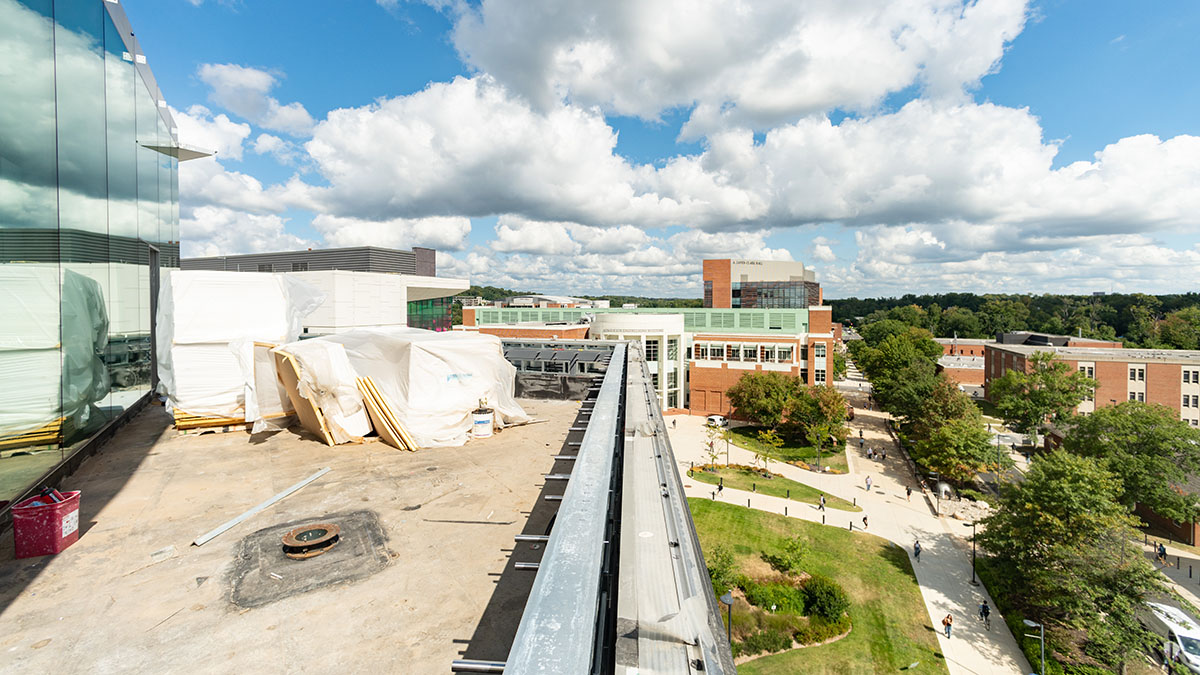
The exterior finishing touches to Zupnik Hall will be evident in early 2026. “In addition to traditional landscaping with planting materials, we will be completing the sidewalks, patios and roadways as the weather warms this spring,” said Olen.
A commitment to student organizations
Zupnik Hall will include spaces for identity-based student organizations including the Society of Hispanic Professional Engineers, Society of Women Engineers, and Black Engineers Society.
“These are places where students can drop in between classes, work on assignments, and connect with each other,” said SPHE President Valery Caicedo, a senior in civil engineering with a minor in data science. “It’s not just about having a larger or brighter space; it’s about what that space represents—a commitment to fostering diversity, inclusion, and innovation.”
Ramping Up Risk and Reliability Research
Matthew Paul, mechanical engineering, ’24, a Ph.D. student in the Center for Risk and Reliability and research assistant in the Systems Risk and Reliability Analysis Lab, is anxious to begin ramping up research. Heavily recruited to the doctoral program by Professor and Director of Reliability Engineering Katrina M. Groth, B.S. ‘04, nuclear engineering, M.S. ‘08, Ph.D. ‘09, reliability engineering, Paul admits the idea of conducting research in Zupnik Hall was a major motivator in his decision to remain at UMD. “The Clark School is constantly building new facilities, introducing new programs, and changing and innovating, which is exactly what engineers do,” he said.
Paul’s work involves hydrogen energy reliability modeling on dysfunctional parts of fueling stations and hydrogen electrolyzers to ensure the safety and high performance of future equipment. In his current lab in the Jeong H. Kim Engineering Building, he takes super high-resolution pictures of decommissioned hydrogen parts, such as pumps, valves, and piping, and identifies the problems. “We do the physics of failure modeling and accelerated life cycle testing, but we are limited in our current space by lack of water, proper ventilation and electrical power,” says Paul, who notes the current space is shared by four distinct research labs.
In the Zupnik Hall lab, fume hoods, exhaust snorkels, sinks, and ample power distribution will allow researchers to advance their hydrogen life cycle research. “We have access to equipment that will allow us to expand our efforts and make research possible that was not previously feasible here,” says Paul. “The new building is a ten-fold improvement.”
The Center for Risk and Reliability will also gain access to the Connected Autonomous Vehicle Lab on the ground floor of Zupnik Hall, which can accommodate a hydrogen vehicle to conduct data tracking and possibly further research.
Expanding Quantum Capabilities
Dengimowei “David” Alabintei M.S. ’25, a Ph.D. student in civil engineering, is interested in the application of quantum machine learning to transportation. “Transportation links to civil engineering, but it also has links to quantum physics and computer science,” said Alabintei. “With the Gaske Quantum Technology Teaching Lab, Zupnik Hall provides great opportunities for quantum machine learning.”
His work currently focuses on rail transportation with the hope to expand into auto and road transportation. His research is funded by the U.S. Department of Transportation in conjunction with data support from ENSCO, Inc., a private sector company that provides engineering technology solutions in the aerospace, national security and surface transportation sectors.&
Alabintei explains, “By applying machine learning to transportation, we can accelerate the decision-making process when it comes to making traffic predictions, optimizing traffic flow, and creating intelligent transportation systems.” He added, “The long-term benefit could be the ability to make on-the-spot decisions to increase accuracy and potentially reduce safety incidents.”
He is excited for the university’s leadership in the quantum field. “The Quantum Technology Center Labs in Zupnik Hall is evidence of additional interest by the Clark School and the university, which could translate to even more research funding,” said Alabintei, whose work will be conducted through the Digital and Cyber Railway Engineering and Operations Center, close to the Quantum Technology Suite.
“It will be exciting to see how Zupnik Hall evolves as the quantum field evolves,” he said. “The design of the building reinforces the concept of interdisciplinary research with future collaboration in mind.”
Founding Donors Fuel Research and Innovation in Zupnik Hall
Stanley R. Zupnik ’59
From a young age, Stanley R. Zupnik knew he wanted to be a builder and real estate developer. The Washington, D.C., native was the first in his family to attend college and earn a bachelor’s degree. In 1964, Zupnik launched his own construction firm, Majestic Builders, which quickly became among the greater Washington, D.C. region’s top residential construction management and general contracting firms. To help position the next generation of engineers to build a smarter future for the good of all, he made a naming gift toward the state-of-the-art Zupnik Hall.
A. James & Alice B. Clark Foundation
A. James Clark ’50 studied civil engineering at UMD on an academic scholarship, before working his way up the ladder at a small local construction company and buying the company. Today, the Clark Construction Group is one of the largest privately held construction firms in the U.S. Throughout his life, Clark invested in UMD and its students to propel the university and Clark School to the forefront of education and research and establishing an array of scholarships, fellowships, and professorships, among other projects. In 2017, the A. James & Alice B. Clark Foundation made a $219.5 million commitment to UMD called Building Together, the largest investment in the university’s history and among the largest to a public research institution in the 21st century. As part of Building Together, the Foundation invested to support the construction of an interdisciplinary engineering building, which would become Zupnik Hall. When it opens in 2026, Zupnik Hall will house the Clark Foundation Legacy Space, an interactive exhibit and student lounge space, which also houses the Clark Scholars Program Network staff offices.
Constellation Energy
Constellation Energy is the nation’s largest producer of reliable, clean, carbon-free energy and a leading supplier of energy products and services, including sustainable energy solutions to millions of homes, institutional customers, the public sector, community aggregations, and businesses, including three fourths of Fortune 100 companies. Its generation fleet of nuclear, hydro, wind, and solar generation facilities powers more than 16 million homes and businesses, providing 10% of all clean power on the grid in the U.S. The Constellation Energy Student Study Space will support an open, bright place for engineering students to study together in groups or individually, in a setting close to classrooms and labs.
Captain Thomas C. Crane ’62, USN, RET
The Capt. Thomas C. Crane Faculty Office will support office space for faculty in the Department of Civil and Environmental Engineering. Born in Baltimore and raised in Catonsville, Md., Following graduation, he joined the Navy’s Civil Engineer Corps, attended Officer Candidate School in Newport, R.I., was selected for the Navy’s Shore Nuclear Power Program graduate school while serving in Puerto Rico, and graduated with a master’s degree in that field from Pennsylvania State University. He retired in 1993 with the rank of captain after a 31-year career during which he was awarded three Legion of Merit medals and five Meritorious Service Medals. He later launched his consulting business and volunteered for the San Diego Police Department. From 2009 to 2018, he was an assistant director in the Public Utilities Department of the City of San Diego, consolidating their water and wastewater departments.
Paul ’76 and Ellen ’75 Gaske
The Paul and Ellen Gaske Quantum Technology Teaching Lab in Zupnik Hall, an instructional lab in the Department of Electrical and Computer Engineering, recognizes the couple’s commitment to advancing educational excellence and technological innovation at UMD. Paul Gaske, who holds a master’s degree in computer science from Johns Hopkins, is the immediate past chair of the Clark School Board of Visitors. He is the chief operating officer of EchoStar Corporation. They have supported the Clark School through the Gaske Quantum Science and Engineering Teaching Lab in the A.V. Williams Building, the A. James Clark School of Engineering Dean’s Fund, and the T. Paul and Ellen Gaske Maryland Promise Scholarship.
Scott ’82, M.B.A. ’86 and Carole ’86, M.B.A. ’86 Greenhaus
The Scott and Carole Greenhaus Building Information Modeling Lab was the first named laboratory in Zupnik Hall. A long-time leader in the construction industry, Scott Greenhaus was with Structural Group, a Maryland-based construction company for more than 42 years, beginning as an intern while studying civil engineering at Maryland. Scott helped shape Structural into a national leader in structural repair and restoration. Scott currently chairs the Clark School’s Board of Visitors.
Rattan L. Khosa M.S. ’71
Rattan L. Khosa came to the United States with an immigrant visa for engineers, having received a research fellowship to study at UMD. He left India with only $8, due to the foreign exchange crisis in India at that time, arriving at UMD with just $3.75 remaining. He went on to earn his master’s degree in structural engineering in 1971. Khosa is the CEO and founder of AMSYSCO Inc., a leading supplier of unbonded post-tensioning systems, barrier cable, and stud rails with an industry-leading manufacturing facility. In addition to funding the Rattan L. Khosa Graduate Endowed Scholarship in Structural Engineering at the Clark School, the Clark School will name Zupnik Hall’s multi-story student space the Rattan L. Khosa Student Lounge.
Robert L. Peskin ’73
Robert L. Peskin was active in the student chapter of the American Society of Civil Engineers and Chi Epsilon. With the encouragement of two of his transportation engineering professors, he attended Northwestern University, where he earned M.S. and Ph.D. degrees in civil engineering. Peskin consults in the areas of transportation financing, planning, and management. A member of AECOM’s transportation consulting practice throughout his entire career, he developed pioneering analytical methodologies in transportation financial planning; analysis of transportation infrastructure capital needs; and operating and maintenance cost modeling. His generosity to the Clark School has funded the Robert L. Peskin Faculty Office.
The Whiting-Turner Contracting Company
Since 1909, Whiting-Turner has been guided by the principles of integrity, excellence, and an unwavering dedication to customer delight. Headquartered in Baltimore with over 60 locations, including College Park, and 5,500 professionals, it provides national reach with local expertise. We deliver construction management, general contracting, design-build, and integrated project delivery services on projects small and large for a diverse group of customers. Whiting-Turner is proud to support UMD and celebrate the opening of Zupnik Hall. Whiting-Turner values the talented engineers from the Clark School who have joined our team, and they hope this new building will inspire future graduates.
Related Articles:
Clean Energy critical for quantum/AI
Capstone Design Expo 2026: Students Solve for Maryland & Beyond
With Engineering Projects, UMD Students Seek to Boost Education Access, Public Health, and Sustainability
Smooth Sailing: MATRIX Dives Into Ship Inspecting
New Graduate Program Teaches Real-World Autonomy Skills
Alchemity Announces New Seed Financing
Solid Oxide Fuel Cell Breakthrough
Aircraft May Refuel Themselves - With Help From AI
Generations of Graduates: A Full-Circle Celebration
Meet the Clark Scholars Class of ’29
February 20, 2026
|




