 |
|
|
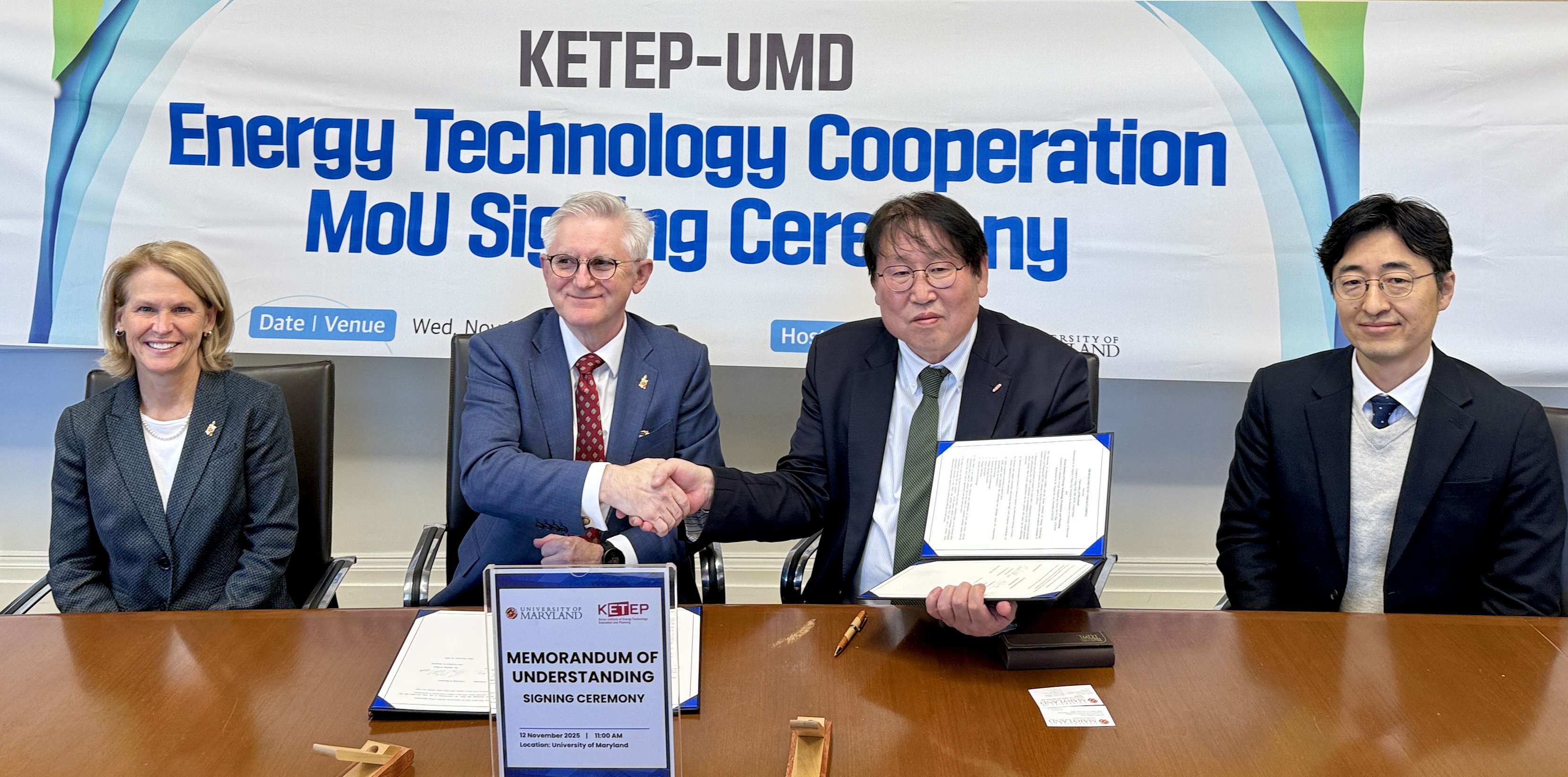
From left to right: UMD Provost Dr. Jennifer King Rice, UMD VP of Research Dr. Patrick O'Shea, KETEP President Seung-Jae Lee, Seungyoung Chung, KETEP (photo courtesy of Cathy Stephens) |
|
On November 12, 2025, the University of Maryland (UMD) and the Korean Institute of Energy Technology Evaluation and Planning (KETEP) signed a memorandum of understanding (MOU) to formalize and strengthen the energy research cooperation between the U.S. and Korea initiated back in March 2024 through the launching of the Korea–U.S. Energy Cooperation Center at the Maryland Energy Innovation Institute (MEI2) at UMD.
This new MOU decisively advances a long-term, strategic partnership built around joint research, academic exchange, and groundbreaking innovation in energy technology. The two institutions agreed to actively promote seminars, workshops, researcher networking, and the development of joint research topics across all energy fields, including renewable energy, energy efficiency, and ESS (energy storage systems).
In a ceremony held in the UMD Provost’s Office, Provost Dr. Jennifer King Rice, UMD Vice-President of Research, Dr. Patrick O’Shea, and KETEP President Seung-jae Lee officially signed the MOU. Both Provost Rice and Dr. O’Shea expressed their enthusiasm in strengthening collaborations between the two institutes.
KETEP President Seung-jae Lee commented, “This MOU is an important milestone that establishes a foundation for sustained joint research. By incorporating the University of Maryland’s strong R&D capabilities into Korea’s R&D system, we expect this to elevate outcomes supporting the nation’s energy transition policies.”
Dr. Eric Wachsman, MEI2 Director, who initiated the collaboration from the U.S. side stated, “We’re honored to host the Korea–U.S. Energy Cooperation Center to strengthen energy research collaborations between our two nations.”
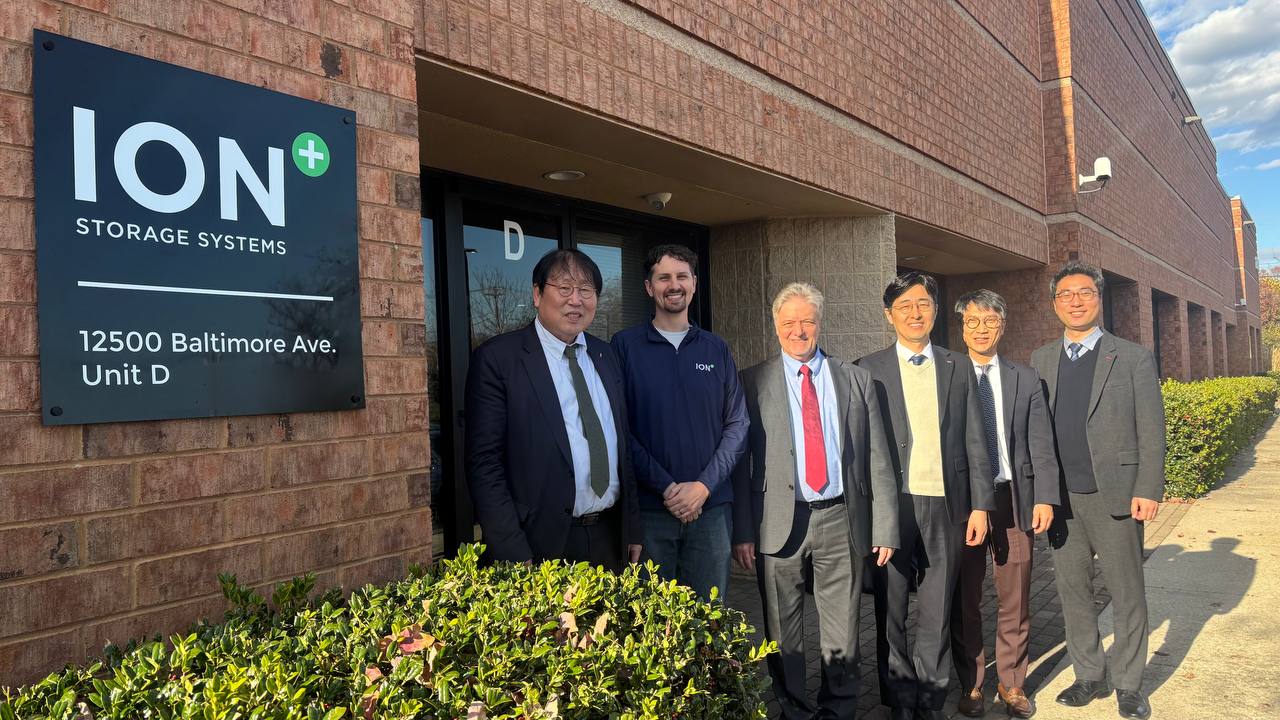
Following the signing, the KETEP delegation visited UMD start up, Ion Storage Systems, for a lab tour and discussion of potential future collaboration in battery technology. (Photo courtesy of Dr. Sunglook Sue - from left to right: Seung-Jae Lee, Robert Whittlesey, Eric Wachsman, Seungyoung Chung, Sang-Joo Baek, and Tae-Hwan Choi)
Earlier in the week, KETEP announced the launch of their “Korean-American Energy Technology and Policy Advisory Council” and jointly hosted an Energy Technology Symposium with UMD. During the symposium, participants presented the latest energy research, and the energy needs to advance AI. Researchers from the University of Maryland, University of Michigan, and University of Florida introduced presented research on batteries, fuel cells, data centers, and AI manufacturing. Teams from the University of Pittsburgh, University of North Carolina, and the University of Cincinnati shared the results of international joint research projects funded by KETEP being conducted with Korean researchers in solar energy, clean fuels, and hydrogen.
Related Articles:
Alchemity Announces New Seed Financing
Solid Oxide Fuel Cell Breakthrough
Alchemity Among 17 MIPS-Funded University Research Projects
Capstone Design Expo 2026: Students Solve for Maryland & Beyond
Anticipation Builds as Zupnik Hall Nears Completion
Clean Energy critical for quantum/AI
New solid-state sodium batteries enable lower cost and more sustainable energy storage
World leader in sustainable construction partners with UMD Start-Up
Transformative Battery Structure Surpasses US’ Fast Charge Goals
UMD ARPA-E project highlighted on Capitol Hill
November 14, 2025
|




