 |
|
|
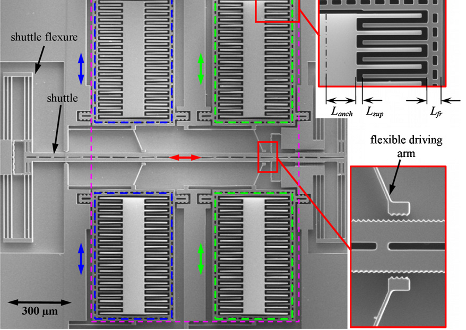
Flexible arms help the shuttle (center) of this nanomotor move. |
|
A tiny creeping motor is easy to manufacture and stronger than ever
Just as a person would grab and pull a rope hand over hand, a new micromechanical motor developed at the University of Maryland pulls a tiny silicon beam with enough force to lift a toothpick.
Assistant Professor Sarah Bergbreiter (ME/ISR) and her student Ivan Penskiy of the University of Maryland, College Park, developed an inchworm motor that is simple to manufacture and provides significantly greater force than similar efforts. Flexible arms are used to alternately grab and pull a tiny silicon beam thousands of times per second, moving only a couple micrometers at a time. This action is similar to that used in muscle. These motors can be used to someday power a tiny insect-sized robot or provide autofocus and zoom in a smartphone camera.
The motor is also very efficient due to its use of electrostatic actuation, in which two tiny silicon plates are pulled toward each other when a voltage is applied. Penksiy and Bergbreiter optimized the layout of these plates along with the flexible arms that they drive to improve efficiency in addition to force output. The researchers made the device in the University of Maryland’s Fab Lab, where only a single etch was required to pattern these plates and flexible arms on a silicon chip.
The researchers will next work on integrating this motor with mechanical structures like legs along with tiny power supplies for integrated microrobots.
January 10, 2013
|




