|
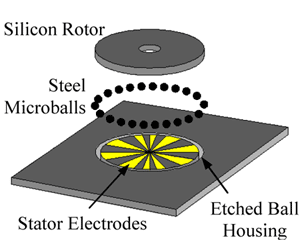
Herbert Rabin Distinguished Professor Reza Ghodssi (ECE/ISR/UMERC/NanoCenter) has received a new three-year, $330,000 grant from the National Science Foundation for research on microball bearing systems with an emphasis on material interfaces for MicroElectroMechanical Systems (MEMS) applications. Ghodssi is the principal investigator (PI) for the research project, titled "Tribologically-Enhanced Encapsulated Microball Bearings for Reduced Friction and Wear in High-Performance Rotary Microactuators and PowerMEMS Devices."
Dr. Matthew McCarthy, a researcher at the Massachusetts Institute for Technology (MIT), is Co-PI. McCarthy previously served as a postdoctoral associate in Ghodssi's research group at the University of Maryland.
The objective of this work is to develop high-performance rotary ball bearings for MEMS using special, tribologically-enhanced thin-film coatings. Particular emphasis will be on the design, fabrication, and experimental characterization of the thin films as hard-coatings to reduce friction and wear in microscale rolling contacts. The results of this will be implemented in a low-friction, low-wear, and long-lifecycle microball bearing for rotary microactuators and PowerMEMS devices.
Ghodssi's team is currently conducting research on the development of compact micro-turbogenerators for small-scale cost-effective power generation and rotary actuator platforms for directional sensor systems. The reliable demonstration of such devices over long life-cycles may have a substantial impact on distributed autonomous systems such as micro-air-vehicles, portable power systems, and sensor networks.
For more information, visit the NSF website.
June 17, 2009
|