|
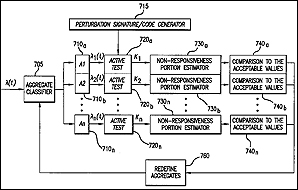
ISR-affiliated Professor Mark Shayman (ECE) and ECE Ph.D. alumnus Mehdi Kalantari Khandani ('05) have been awarded US Patent 7,391,740 for "Method for quantifying reponsiveness of flow aggregates to packet drops in a communication network." Shayman is the associate dean for faculty affairs in the A. James Clark School of Engineering, and Khandani is currently an assistant research scientist in the Electrical and Computer Engineering Department. Their invention can be used as a component in fair congestion control or in mitigating distributed denial of service (DDoS) attacks of the Internet.
In a communication network, the responsiveness of the transmission rate of data packets to packet drops is quantified for an aggregate of flows as opposed to on a per-flow basis. In an Aggregate Perturbation Method (APM), a small number of data packets is intentionally dropped from the aggregate at a switching node and a response thereto is measured. Traffic not conforming to the predetermined transmission control protocol may be discovered as a decrement in the reduction in traffic rate compared to that anticipated based on the rate of dropped packets. To prevent interference from the simultaneous application of APM at multiple switching nodes, an orthogonal drop rate signature defining the instantaneous drop rate is assigned thereto. The orthogonal drop rate signature is based on the code division multiple access (CDMA) coding of data, and for that reason, APM with the application of orthogonal drop rate signatures is termed CDMA-based APM, or CAPM.
You can view ISR patents at any time on our patents page.
June 27, 2008
|