|
The University of Maryland hosted its first Maryland Semiconductor retreat on November 6, 2025, convening nearly 100 UMD researchers for a full-day event designed to unify the university’s efforts in semiconductor research, workforce development, and national engagement. The purpose and motivation of the event was to focus on internal UMD expertise and create a unified UMD community around the semiconductor area.
Led by Professor Ankur Srivastava, UMD’s newly appointed Director of Semiconductor Initiatives and Innovation, the event brought together faculty from engineering, physics, materials science, and computer science. The retreat served as a launch point for coordinated campus-wide activity aligned with priorities of the CHIPS and Science Act and other related opportunities.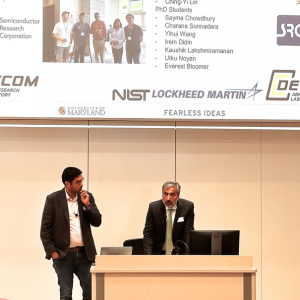
“This was our first step in building a shared, strategic vision,” Srivastava said. “We now have a clear picture of the work happening across UMD and the opportunity to bring that together in a powerful way.”
Sessions throughout the day highlighted cross-cutting expertise in AI hardware, secure chip design, quantum electronics, heterogeneous integration, packaging, reliability and semiconductor materials. Faculty also shared emerging research on wide-bandgap power electronics, thermal management, and co-design across devices and systems.
The agenda included updates from UMD facilities leaders on fabrication and testing capabilities, as well as a spotlight on early-stage industry partnerships in magnetic imaging and autonomous thin-film manufacturing.
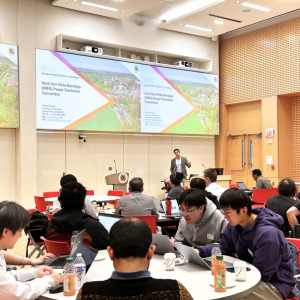
The workshop was also an inflection point for longer-term planning. During a facilitated strategy session, participants began drafting a campus-wide vision to guide investment, infrastructure development, and external partnerships. Topics included aligning graduate education with workforce needs, scaling research in secure hardware and edge systems, and establishing a national profile in areas such as chip-packaging security, AI-enhanced design, and emerging materials.
 Srivastava’s appointment as the inaugural director of UMD’s semiconductor initiatives builds on years of leadership in the field. He currently serves as co-investigator on the Secured Edge Project, supported through the Midwest Microelectronics Consortium, and has played a central role in national partnerships with Booz Allen Hamilton, Northrop Grumman, Battelle, and NVIDIA. Srivastava’s appointment as the inaugural director of UMD’s semiconductor initiatives builds on years of leadership in the field. He currently serves as co-investigator on the Secured Edge Project, supported through the Midwest Microelectronics Consortium, and has played a central role in national partnerships with Booz Allen Hamilton, Northrop Grumman, Battelle, and NVIDIA.
“This is a space where academia, industry, and national security priorities are deeply connected,” Srivastava said. “We are positioning UMD to lead where it matters most.”
The event was hosted by the A. James Clark School of Engineering and supported by campus research leadership. Future workshops will expand to include more industry participation, student research presentations, and external stakeholders across government and academia.
The workshop also marked the beginning of a new chapter in UMD’s role within the national semiconductor ecosystem. Faculty and partners are now building momentum toward large-scale proposals, new research centers, and interdisciplinary educational programs designed to shape the semiconductor workforce of tomorrow.
Related Articles:
Smooth Sailing: MATRIX Dives Into Ship Inspecting
UMD Joins NSF's $400M AI Nanofabrication Initiative
New Speech Model Reads Mouth Movement Across Languages
Grand Challenges 2.0: Engineers Partner to Unlock Solutions
Aircraft May Refuel Themselves - With Help From AI
OmniSpeech Launches Real-Time Voice Deepfake Detection
Sensor Advancement Breaks Barriers in Brain-Behavior Research
MATRIX Faculty to Present at International Conference
University of Maryland Represented at International Forum
UMD Student Bridging Research Innovation and Education Advocacy
November 14, 2025
|





