|
ArtIAMAS, a pioneering five-year collaborative initiative between researchers from the University of Maryland College Park (UMD), the University of Maryland Baltimore County (UMBC), and the US Army Research Lab (ARL), is now entering its third year of the program.
This comprehensive project is dedicated to advancing cutting-edge technologies across diverse domains including engineering, robotics, computer science, operations research, modeling and simulation, and cybersecurity. These technologies are meticulously designed to operate autonomously while seamlessly complementing human capabilities.
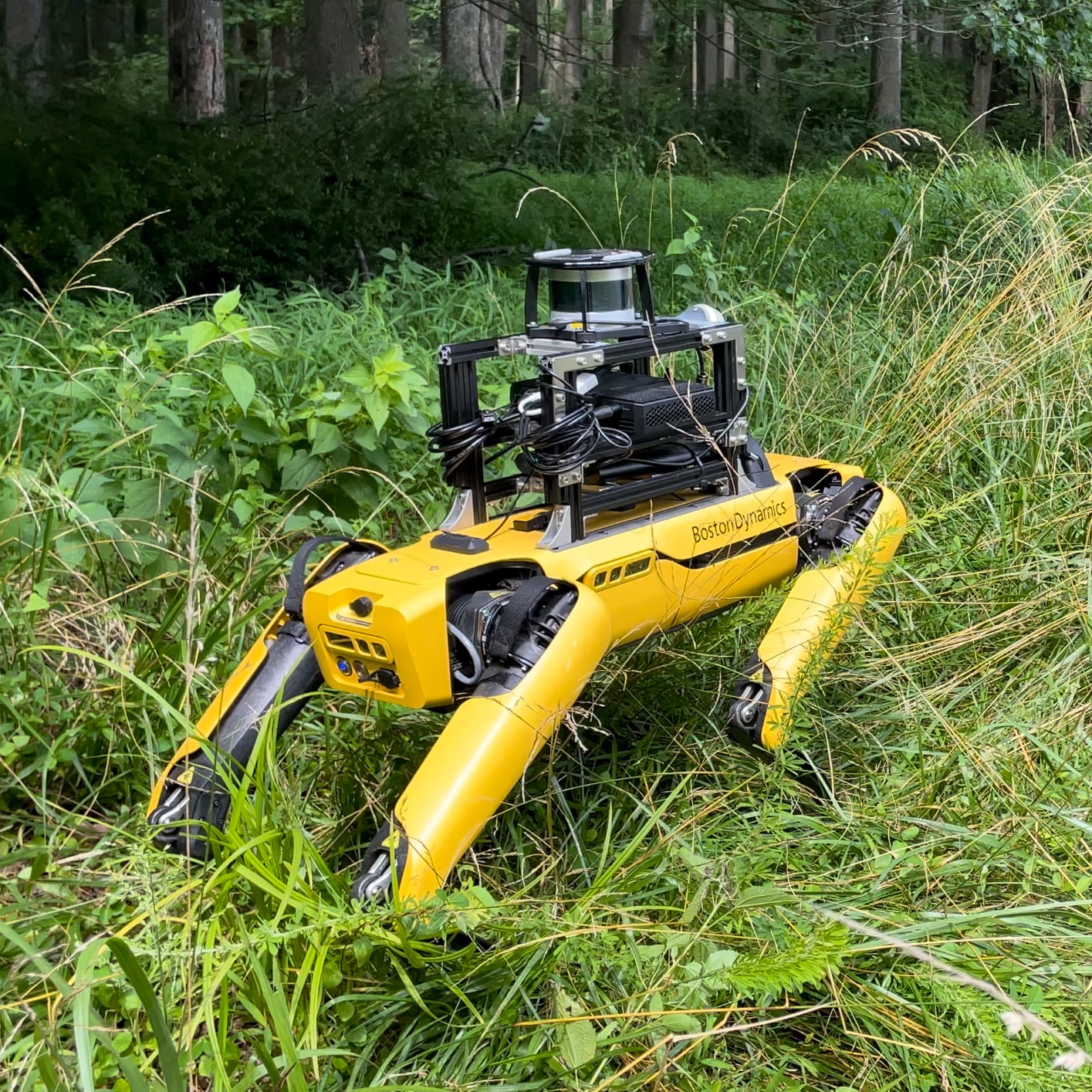
The UMD Gamma Lab, led by Distinguished University Professor Dinesh Manocha (ECE/CS/UMIACS), stands as a cornerstone contributor to the ArtIAMAS program. Their groundbreaking research, with a particular focus on ground autonomy utilizing the Boston Dynamics Spot quadruped robot, has garnered profound recognition from ARL. Their primary objective revolves around creating an autonomous navigation system that empowers the Spot Robot to navigate adeptly through dense vegetation, towering grasses, intricate trees, and thickets. Additionally, their work equips the robot with the remarkable ability to detect obstacles and navigate around them.
In their recent publication titled 'VERN: Vegetation-aware Robot Navigation in Dense, Unstructured Outdoor Environments,' Manocha's research group, including PhD students Adarsh Jagan Sathyamoorthy from UMD’s Department of Electrical & Computer Engineering (ECE), Kasun Weerakoon (ECE), Mohamed Elnoor (ECE), Jing Liang from UMD’s Department of Computer Science (CS), and Tianrui Guan (CS), has pushed the boundaries of their research by identifying additional challenges that can impede a robot's navigation through dense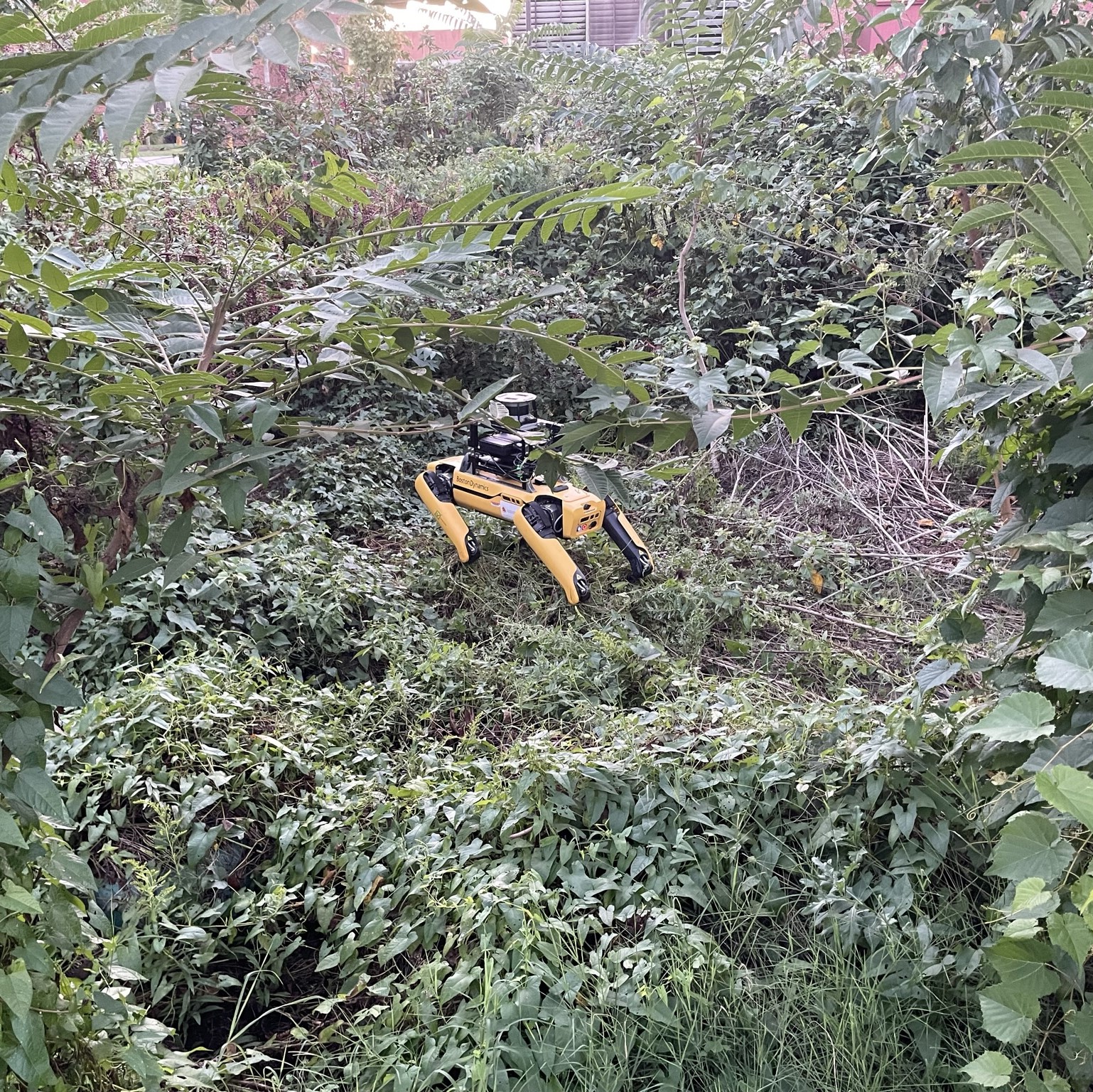 vegetation. Furthermore, they have proposed practical applications to effectively overcome the obstacles such as the risk of the robot becoming immobilized and entangled within various types of vegetation. vegetation. Furthermore, they have proposed practical applications to effectively overcome the obstacles such as the risk of the robot becoming immobilized and entangled within various types of vegetation.
The collaborative efforts of ARL researchers Mason Russell, Damon Conover, and Jason Pusey, with the UMD faculty and students, have resulted in the development of innovative technologies to tackle this challenge. These advancements will not only enable robots to recover from such situations effectively but also serve as a foundation for future research aimed at improving navigation within these complex environments.
The Clark School of Engineering (UMD) has cultivated a robust research partnership with ARL spanning over a remarkable 25-year period. This partnership has consistently emphasized the domains of AI, autonomy, modeling, and simulation. Notably, the funding designated for the third year of the ArtIMAS project represents one of the most significant single-year sponsored research awards in the prestigious history of the Clark School.
October 31, 2023
|